


By Nicole Pope
At the conclusion of Monday's Beach House show in Omaha, sultry songstress Victoria Legrand told the crowd, "This will be our last song." Yeah yeah, I thought, as I always do. You'll be back.
The band left the stage, and after some feeble clapping from the audience, the lights came on. I wasn't mad -- I mean, she did say it was their last song -- but I couldn't help feeling I might have heard a few more gorgeous gems if our crowd had somehow done something differently.
Such is the natural result of the encore setup. Let's consider what was intended to be the point of an encore. The band plays a riveting show. The crowd is into it. The band is into it. They end their set, go back stage, but then gosh darn it, they just aren't ready to pack up and leave. The crowd wants more, and perhaps more importantly, they want to play more (or at the very least show appreciation for an attentive and energetic crowd).
If you're like me and attend a lot of shows, you know that you can expect to see an encore at 95% of shows. So where does that leave the other five percent who, for whatever reason, decide to forego the farcical "I'm leaving the stage until next time, but not really"?
I admit, there are times I've left a show feeling short-changed. Usually it's because of what seems like a shorter-than-normal set (a feeling that's exacerbated if I've seen the band multiple times). Usually, though, I only feel truly disappointed when a band leaves the stage and the audience starts to clap, the lights stay dimmed, and we're just clapping and clapping for minutes until -- nothing. (An otherwise lovely Joanna Newsom show comes to mind.) Does a band have to play an encore? No. But should they play an encore if they've allowed the audience to partake and partake and partake in their side of the facade, until their palms are sore and their throats hoarse? Yes.
So there should be rules for encores, perhaps. Such as, if a band has no intention of playing an encore, the lights/house music should turn on immediately. (Though how do you account for a band wanting to play an encore, yet receiving little encouragement from a crowd and thus changing their mind -- I've been in those scenarios before, too.) Maybe more bands should only say "This is our last song" when they mean it -- though, again, wouldn't that be taking away the original point of an encore?
Should we just get away with encores all together, and thus all the lukewarm encore performances from bands who feel like they "have to play one"? How can we bring back the excitement of not knowing if you're going to get an encore and then getting one, without the backlash some bands receive from occasionally not playing one?
What do they do backstage for that minute while we stand out there desperately cheering, anyhow?
Interestingly, there is a web site called Second Encore that addresses many of the concerns I've discussed here. This is a site dedicated entirely to "saving the encore." Here is their mission:"Second Encore is a campaign set-up by a group of friends that love live music and are no longer happy with the single obligatory encore most bands do. We are trying to gain support from like minded fans to show bands that we want more from an encore, not just the always predictable walk off walk back on 2 minutes later routine."
The site then goes on to list ways you can tell if an encore is "a pre-planned mediocre addition to the set," including, "When the band leave their best songs out of the main gig only to play the hits in the encore," or "When you get that feeling if you clap or not they are coming out anyway." Second Encore implores like-minded individuals to join their campaign by banding together and doing things like saving the majority of your applause for the end of the first encore, so that the band will absolutely have to return for another.
Wow. You tell 'em, guys. While I understand the frustration, I can't help but think, you guys are fans, right?
Aren't these feelings of entitlement the precise reason we're in this encore debacle in the first place?
Friday, March 28, 2008
Column:
Are Fans Entitled to an Encore?

Friday, March 14, 2008
Column:
Pondering the Album
By Nicole Pope
Each week I ask myself several music-related questions. Some become seeds for a column; others hibernate until my next round table discussion with fellow music nerds. Lately I've been pondering THE ALBUM. Rather than choose just one, I thought I'd bring you a medley of musings.
Yes, I just said medley of musings.
Why don't fans identify themselves with ALBUMS rather than BANDS?
This one's been bugging me for a while. You see, I have very few favorite bands. As in, there aren't many bands I would feel comfortable identifying myself with. Prime examples: Wilco. Interpol. I adore Yankee Hotel Foxtrot and Turn on the Bright Lights, but not so much the later schlep. So will you ever hear me say Wilco or Interpol are my favorite bands? Hell, no. But Yankee and TOTBL are two of my favorite albums. Therein lies the rub.
Is it just that bands are more convenient touchstones? Like, "I dig The Arcade Fire." Or, "I heart The Shins." When what you really mean is, "I love the shit out of Oh, Inverted World. And Funeral is just tops"?
A related question: Do latter, lesser albums devalue their excellent predecessors?
Does Yankee Hotel Foxtrot lose its importance because it may be a fluke? As a fan it's hard for me to listen to an album like this without feeling bittersweet. Certainly I still appreciate the album, but I can't help thinking it's been prostituted by several subsequent albums rehashing the same sound, themes, etc.
Take The Flaming Lips' "My Cosmic Autumn Rebellion," from their most recent album At War with the Mystics."They tell us "Autumn's a comin' and soon everything around us will die... They only see the obvious. They see the sun go down, but they don't see it rise."
 Hello! Does anyone else see the obvious ripification of "Do You Realize?"? Yeah, yeah, the sun isn't really setting. It's just an illusion caused by the world spinning round... People don't really die... I got it, guys. While I hate "My Cosmic Autumn Rebellion" for being so unoriginal, I also feel like it somehow lessens the impact of the original song.
Is it just that an artist has said what they wanted to say, and now they're just splashing around in the puddles?
Or is the exact opposite of my initial point true: that because a band never achieves that same level, it makes the album that much more significant?
And some age-old questions: Will THE ALBUM format die as bands begin focusing on songs rather than cohesive albums? Will the album ever be an exclusively online creation? Will record labels die in the wake?
Before Hail to the Thief was released in '03, I read a Filter interview with Thom Yorke about his desire to abandon the album format in favor of EPs. As Radiohead is known for its concept albums (Kid A being perhaps the most impressive), this news saddened me considerably. Thankfully, the band has put out not only one but two more albums since this declaration. Still, the unconventional In Rainbows release has me considering this question once more. Could bands do away with record labels all together, and release all of their material online? And if this happens, will they begin peddling their music to ITunes and its focus on the single download -- which might lead artists to focus on individual songs rather than entire albums?
Once more I think of someone I know who downloaded "My Body is a Cage," his only exposure to Neon Bible. Or "Suffer for Fashion," his only track from Hissing Fauna. Ironically, he now goes around calling himself an Of Montreal or Arcade Fire fan, which circles back to my earlier question in an intriguing way. Could music fans start identifying themselves not with albums, but with individual songs?
What ripples will this have in the music industry? Will there come a day when we lose the concept album, or will the bands' love of music and creativity halt this process?
Friday, March 7, 2008
Column:
What Does Your ITunes Play Count Say About You As a Person?
By Nicole Pope
Ordinarily in this column I try to answer a big question I've pondered recently. Today I awoke to yet another suffocating blanket of snow. Just like that, my energy was zapped.
So I decided to do something fun like checking my ITunes Play Count (You know, sorting your music using the "Play Count" tab - after "Rating" - or simply viewing your "Top 25 Most Played" playlist.) Incidentally, ITunes collects this data in order to make Smart Playlists. If any of you have ever tried allowing ITunes to make, say, a party playlist for you, you know it's not the smartest AI around. Something cool and party-friendly will come on, like "The W.A.N.D.," and then ITunes will blow it by playing "Tears Are In Your Eyes" (sorry, YLT).
Lately I've thought it might be funny to write one of those lame quizzes and ask, "What Sub-Genre of Indie Rock Are You?" I thought I knew what my answer would be, until I started reading way too much into my play counts.
Do you ever wonder how other people truly see you? Well, check your ITunes play count and you might catch a glimpse of the undeniable truth of your soul. It's like ITunes is whispering in that trademark Nico hush, "I'll be your mirror." (A song that currently has a Play Count of 13.) And I was just trying to write a mindless column today.
Well, Yeah, You Got Me.
My No. 6 most listened to song is The National's "Green Gloves" (36 listens), while "Guest Room" is gaining at No. 14 (33 listens).
Panda Bear's "Take Pills" comes in at No. 11 (34 listens). (WTF? This isn't even close to my favorite on the album???)
Deerhunter's "Cryptograms" takes the No. 20 spot (31 listens), with "Hazel St." closing in at No. 26 (29 listens).
And despite having only been in my possession for two months, pretty much all of Beach House's Devotion, as expected, is moving toward a top spot with the majority of its tracks at 22 listens, and "You Came to Me" with 27.
Other top contenders: Iron & Wine's "Evening on the Ground" (31), Feist's "The Water" (31), The Field's "A Paw In My Face" (29), Of Montreal's "Gronlandic Edit" (28), Badly Drawn Boy's "Everybody Stalking" (28), Yo La Tengo's "Flying Lessons (Hot Chicken #1)" (28).
Really? Are You Making This Up?
Here's where the mirror comes in, and I was quite surprised by what I saw.
Overwhelmingly, my No. 1 song was "The Well and the Lighthouse" by The Arcade Fire (40 listens). This means that either my husband or I secretly love Neon Bible more than we've let on. Or that "The Well and the Lighthouse" is a fucking great song. Which it is.
Interestingly, Hot Chip's The Warning made two appearances in my Top Ten, including "Just Like We (Breakdown)" at No. 4 (37) and "Look After Me" at No. 7 (36). This isn't too much of a shocker because, while certainly not one of the best albums ever, The Warning suits so many moods. (Just look at the range represented by those two tracks.)
The biggest surprise for me was seeing songs from Blonde Redhead's 23 at the top of the list. "Publisher" nabbed the No. 2 spot with 38 listens (I'm looking at you, Backdrifter), while "Spring and By Summer Fall" came in at No. 8 with 35 (that one's my doing.)
Mitigating factors: I've had ITunes for about a year and a half, which might account for the prevalence of some of the albums coming out around that time (23 and Neon Bible). These figures don't account for what I listen to in my car, which is a considerable amount of the time I spend listening to music. It also doesn't account for whole albums, only songs, which I assume would give an entirely different result altogether.
So what did all of this tell me? Well, I was surprised to see that I'm not as much of a sad-bastard music lover as I thought. It also shows me that some of the albums/bands I've been criticizing lately have at one time been a predominant presence in my music collection. Because of this it also shows the fleeting nature of taste and, really, obsession.
So everyone, when you get a chance, take a peek at your ITunes Play Count. You might be surprised by what you see.
Friday, February 29, 2008
Column:
The Fallacy of Pretty, Pretty Production
By Nicole Pope
After hearing new singles from Islands and Tapes N Tapes, I’m apprehensive. Already I fear they’ll be added to the heap of bands that had their eye on the prize and left with honorable mention. Why? Both songs left me feeling like I ate too much bread before my meal: all yummy filler, yet surprisingly little substance.
I’m talking about production here.
The Shins. Modest Mouse. Blonde Redhead. Interpol. Sigur Ros. One could even make a case for The Arcade Fire.
All have embraced a markedly prettier production on their recent albums, yet have made one of their weakest (or in many cases, hands-down weakest) albums yet.
What’s going on here?
Is it simply that as bands increase in popularity they get more money, and so like all those anemic Hollywood blockbusters, pile that dough into aesthetics?
Or that obsessing over the production leads artists to overlook the essentials of the craft?
Or that the overproduction is an attempt to bolster skeletal song writing?
Is it misguided or misguiding producers?
Attempts to please a newly demanding record label?
Attempts at grandeur that fall flat?
Or is it just that the quality of the band’s current output doesn’t justify all the histrionics? Make no mistake, a better sounding song does not necessarily a weak song make. Look at The Flaming Lips’ The Soft Bulletin, maybe the most produced album ever. Or on a lesser scale, an album like Blonde Redhead’s Misery is a Butterfly. Here the band moved toward a glossier sound, though the production complemented its meandering sparseness (I’ve heard listening to the album compared to watching a French film.) Another more recent example: Iron & Wine’s The Shepherd’s Dog. This is perhaps the most extreme sonic shift, as we go from crackling tracks like “The Sea and the Rhythm” to the multi-layered, reverb-heavy “Carousel.” And yet, the album is a resounding success.
Is this simply the case of “I fell in love with The Shins because of two-minute tracks like ‘Girl Inform Me,’ and now they’re peddling Zunes with their oversexed, overblown new singles”? (I’m unfairly knifing “Sleeping Lessons” here, which is admittedly the best song on the album. But maybe that only proves my point.)
Is it just that some bands are better at making the transition from lo-fi to pretty, pretty production?
Maybe I’m being petulant here, but why do they have to make the transition?
Friday, February 22, 2008
Column:
Is It Fair to Judge People Based on Their Music Taste?
By Nicole Pope
Once a semester I assign my students an analysis paper. Theoretically I could make them analyze anything: literature, abstract art, U.S. foreign policy, that year’s KU basketball team. Since it doesn’t matter what they are analyzing so much as how they are analyzing it, I ask them to write about something they are passionate about: their favorite music.
This assignment reveals far more about my students than, say, essays about the environment or smoking bans or the death of a grandparent. Suddenly I see them through a new lens: the quiet girl always hiding her Sudoku under her desk who loves Rilo Kiley, the hard-working Daddy’s girl who still listens to Daddy’s music (Lionel Ritchie), the kid in the back wearing a “Nausea” hat that isn’t really a commentary on his feelings about this class or life, but rather an advertisement for his favorite band.
It’s also the assignment with the potential to bring me closest to my students. I’ll never forget the girl who wrote an analysis of Animal Collective’s “Grass,” or the one who came to my office for help comparing Interpol’s “The Specialist” to Badly Drawn Boy’s “Everybody’s Stalkin,” or the student who compared descriptions of God in Sufjan Stevens’ “Casimir Pulaski Day” to those in Modest Mouse’s “Bukowski.” For perhaps the first time in the semester, these students and I were speaking the same language.
I’ve wondered about this connection, and whether it’s fair to bond with some people and not others based simply on music taste. Certainly others forge similarly shallow camaraderie based on films, art, politics, religion, television shows, and so on. Is it so wrong that for me at least, music is the number one barometer?
At times I feel like the characters from Wonder Boys, who scrutinize passersby and imagine their life stories: “He’s a groomer named Claudelle.” “He lives with his mother.” “He blames himself for his brother’s death.” Except I’m looking at people and guessing their music taste, like “I bet she adores Joni Mitchell,” or “He’s totally in a Slipknot tribute band,” or, “That hipster wannabe is a total Deathcab fan.”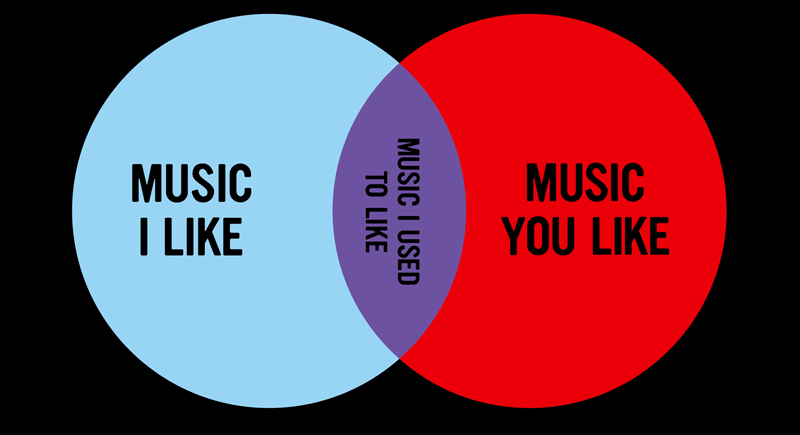
To be fair, sometimes I am dead wrong about someone. Like the kid who I pegged as a SY/MBV fan, until he handed in his paper over chamber music. (No, not chamber pop, chamber music. Like Gregorian chants. Still, it could have been far worse.) Or the kid with the D+ average who adored Sufjan Stevens and Iron & Wine. He might not have been able to articulate why he adored them, but should that be a requirement for liking something? This time I can resoundingly say no.
My pretentious theory gets even more messed up when I think of my mother. I don’t want to just write her off, you know, even though not too long ago she did make me endure a diatribe about how Christina Aguilera was sooo much more talented than Britney Spears. Sometimes I make her mixes with safe bands I know she’ll like: Spoon, The Decemberists, Cat Power. Then she’ll call and say, “I finally listened to that CD you made me. That one kind of country-ish song has the f-word in it, but I still really liked it.” (“A History of Lovers” by Iron & Wine.) I’ll never forget the time she called me on her birthday after a couple glasses of wine and said, “I just wanted you to know. Arcade Fire. I get it now.”
So on subsequent mixes I get a little braver. And a little braver. Once I made her a mix with Sigur Ros and Sleater Kinney on it. I never did hear her thoughts on that one, though sometimes I imagine her sitting in her car listening to it. Trying to figure it out. More than likely, she’s trying to figure me out.
(Note: As much as I wish the nifty snobby graphic above were my creation, it's not. I took it from here, where incidentally you can also buy the T-shirt.)

Friday, February 15, 2008
Column:
Are Solo Albums Good or Bad for the Band?
By Nicole Pope
Last year seemed to bring an exorbitant number of solo releases, from lovers Feist and Kevin Drew to Thurston Moore to Panda Bear. Ordinarily the very idea of a solo album leaves me lukewarm, yet 2007 proved if not incredible on all accounts, at least intriguing.
Why do artists record solo albums, I've wondered, and are they a sign of a healthy collaboration with a band's fellow members, or the heralding of the end? Perhaps it's crucial to draw a distinction between solo albums that allow a musician to grow on his or her own terms, and those that seem to be merely a rehashing or watered-down version of the music performed by the full band.
I can't say enough about Panda Bear's sophomore triumph Person Pitch. Here, in my mind, is an example of an album that is so distinctly PB, it simply could not have been an Animal Collective release. Noah Lennox said, hey, I have something to say outside the scope of the band, and he made that happen. Then AC reconvened and recorded Strawberry Jams, an album that further showcases the talent Panda Bear exhibits on PP, without damaging the band's cohesiveness. A strong solo release, in Animal Collective's case, made for a stronger band. Most solo albums, on the other hand, fail to push an artist's sound beyond that of their full-time band. Thurston Moore's Trees Outside the Academy contains a handful of impressive tracks, including the incredible "Silver Chair," yet ultimately disappoints. Why? Because as one of the major players in Sonic Youth, arguably one of the best rock bands EVER, I think we all expected so much more. The same could be said about Thom Yorke's The Eraser. This is an enjoyable record, no doubt, but was anyone else disappointed that -- both lyrically and musically -- Thom could be so normal? And don't even get me started on Stephen Malkmus.
So maybe all this proves is that the push and pull of multiple band members is critical. (Any Verve fan who's tried to listen to Richard Ashcroft's solo material can speak to this point.) Beyond simply being lackluster, though, some solo albums seem to signal trouble amongst the ranks. I've already expressed my fears about The New Pornographers, whose multi-talented members as of late seem to be pouring their best material into their individual careers. I have similar fears following the success of Feist's The Reminder. Will Broken Social Scene soon have to subsist without the talented songstress, leaving us with merely Broken Social Scene Presents Kevin Drew? (Shudders.)
Lastly, with some solo artists I wonder, why bother? This April Colin Meloy will release a solo album. Beings that Meloy is the heart and soul of The Decemberists (penning both the music and lyrics), I'm not sure what the point of a solo album would be. If you ask me, this makes about as much sense as a Kevin Barnes or Sam Beam solo album. Am I missing something here?
Friday, February 8, 2008
Column:
Why I Can't Love Elliott Smith
By Nicole Pope
Recently a friend said to me, "You are one of the few people I know who aren't obsessed with Elliott Smith." Ordinarily after a comment like this my music-nerd alarm would go off, and I'd think, It can't be! I can't be the only one who doesn't get it! And I would promptly run to my computer and begin researching, listening, digesting.
The truth is, I know the stranglehold Smith's legacy has on music fans. It's the precise reason I've sidestepped his vast, impressive collection.
Recently my husband was telling me about one of his coworkers who is obsessed with Elliott Smith. As obsessed as he could be, I guess, without knowing about Smith's tragic suicide. It's been nearly five years since the 34-year-old stabbed himself not once, but twice, in the heart, leaving legions of fans feeling similarly wounded. Of course, there are those who say Smith's death wasn't a suicide at all. These conspiracy theorists are the ones who have the hardest time saying goodbye -- keeping the mystery of his death alive keeps the mystery of the man, and more importantly his music, alive.
Unlike my husband's arguably lucky coworker, I knew all the grisly details of Smith's suicide before encountering his music. Last year when the posthumous B-side/outtakes collection New Moon was released to critical acclaim, I downloaded the album, and after a cursory listen, tucked it away for another day. Perhaps the title too eerily resembled Nick Drake's somber farewell Pink Moon. Every time I've come near New Moon or any of Smith's albums, I hear those tinges of isolation, desperation, fatalism -- feelings many of my favorite artists express, yet will never act on as Smith did.
Perhaps my aversion to Elliott Smith deals with why I listen to sad music in the first place. Some of my friends say they cannot listen to singer-songwriter-type-music because it takes them to a dark place. I, on the other hand, listen to that music to suit my mood, and, after wallowing in it for a bit, to eventually emerge grateful, optimistic, content. Literature critics say you cannot assume the writer is the narrative voice in a work -- regardless, I can't listen to Elliott Smith without being reminded of the bleakness of the world, the futility of our dreams, and ultimately, the certainty of death.
Once more I'm reminded of the rhetorical question, "What came first, the music or the misery?" Do I listen to Elliott Smith because I'm miserable? Or am I miserable because I listen to Elliott Smith?
Friday, February 1, 2008
Column:
You're Never Too Old to Appreciate Music
By Nicole Pope
My friends fall into three categories. One, those who ravenously follow new music to the point that they've barely had time to digest an album before the next one comes along (myself included). Two, those who faithfully follow their favorite music from, say, ten years ago. And three, those who fall somewhere in between. The third group is probably the most balanced, sane, and well adjusted. The ones I worry about are not the music whores, but those who have essentially given up on music that isn't force-fed via their local radio.
A friend has a fitting proclamation on his Myspace profile right now: "I live for music... constantly listening to it and going to concerts since I still haven't made that last step of growing up." Certainly I'm pleased music is a big part of his life, though his comment echoes a common, unfortunate sentiment. That when we grow up, music should stop playing an important role in our lives. That eventually we will settle down with the soundtrack from our youth, just like our parents listening to the oldies station.
Last year Pitchfork writer Mark Richardson talked about how getting older has affected his relationship with music. He writes,"If you're 22 and listening to college radio, with a dorm building filled with buzzing hard drives packed with files, it's not hard to keep your finger on the pulse and to find new bands that interest you...But for someone who has to work 40 hours a week to pay a mortgage and feed his or her kids...time is precious."
Certainly keeping your finger on the pulse of the music scene can be demanding. And maybe it's only because I don't work a forty-hour week to support a family that I can be so holier-than-thou. Still, I'd like to think that no matter what course my life takes, music will play a pivotal role. Finding new music is demanding, but well worth the time it takes to chat up a music lovin friend or cue up that torrent.
So all of you still clinging to those bands of yesteryear, I'm not asking you to give up on your old favorites. I'm only asking that you consider them a step in your musical journey, one that you will continue to take throughout life.
Friday, January 25, 2008
Column:
You Came to See the Show; Now Shut the Hell Up
By Nicole Pope
During his 2006 Sunken Treasure tour, Wilco's Jeff Tweedy had this to say during one all-acoustic set:
People who are talking during this performance, I have a question for you. What can I do to be of a better service to you? Am I not playing the right songs? Am I not pouring my heart out up here for you? Tell me what I need to do to get you to listen to the concert that you paid money to go see. I'm serious... I want to make you happy. And if you're happy talking, then why did you come here?
Tweedy received quite the backlash for his comments from fans. Looking at the YouTube video of this diatribe (which I highly recommend you view), you'll come across some praise, but also comments like, "When did Tweedy become so whiney?" or "No performer should bitch about the people who put food in their mouths."
 Many of these fans suggest that talking during a concert is their right. But what about the rights of those who paid to see the band and actually want to listen to them?
Case in point (bear with me as I relay just one more scene-setting YLT anecdote): This past weekend, just a few songs into Yo La Tengo's acoustic set, a crowd of drunken buffoons entered the venue and, completely clueless to the spellbound crowd of devoted fans surrounding them, proceeded to start shrieking and, as my grandmother would say, "carrying on." And I thought the last YLT concert was bad, when that couple behind me kept giving each other the play-by-play during "Tiny Birds," one of the band's most subtle songs: "Just wait for that cymbal coming up. The soothing drum roll. Oh, just listen to Georgia's harmony." Yes! Please listen to it! I wanted to say.
I doubt anyone will disagree that loud talking during an intimate acoustic show is completely out of line. But what about those girls yakking away at The Shins show last winter, or The New Pornographers, or that notoriously loud harpy at The Decemberists years ago? I know what you're thinking: just ask them to be quiet. I usually try delivering evil glares until it's clear this method won't work, at which point I kindly ask if they could maybe-possibly-kinda keep it down a bit. And you know what happens every time? I'm met with an animosity as intense as if I'd just told them they shouldn't come to a Shins show because they heard that one song on the radio, or because this hot guy from Phi Delt likes them, or because Natalie Portman said they were really rad.
For this reason I have to thank Mr. Tweedy for doing the dirty work for concert goers like myself who, you know, just want to go to concerts. I'm not saying you have to be as passionate about the music as I am, just don't ruin it for the rest of us.
Thank you for listening.
Friday, January 18, 2008
Column:
The 'Narcotic Need' for New Music
By Nicole Pope
There's a new Beach House song called "Gila" that I cannot stop thinking about. Over the past week I fell so disgustingly in love with it. I listened to it over and over and over again. I hummed the song in my husband's presence, belted it out with full-lung-capacity when he left for work. I wanted to be Victoria Legrand. I wanted to sing in a girl-boy band, dress like a ragamuffin indie star, sing with such somber austerity.
Then, just like that, I heard the song for the umpteenth time, and to quote The Flaming Lips, "suddenly, everything ha[d] changed." The rush was simply over.
I'm familiar with this sort of burn out, and typically avoid over-listening to something for this precise reason. It's why I listen to full albums rather than individual songs. It's why I now skip "Svefn-G-Englar" or "Cybele's Reverie" or "The Past and Pending" or the first three tracks off The Moon and Antarctica or even "Paranoid Android" (though mainstream radio is responsible for burning me out on that song long before I heard it in context of the album).
So what leads to this binge-and-crash relationship with new music?
In his collection of essays titled Songbook, Nick Hornby describes what he calls a "narcotic need" for music. He discusses a theory posed by music critic Dave Eggers, that we play songs over and over and over again in an attempt to "solve" them. This theory definitely holds true from my standpoint. When I hear something new, it challenges me, forces me to look at it from different angles, to scratch at the varnish and wires and rusty nails until I get at its shivering, naked core. Unfortunately, the mystery only lasts so long. I guess you could say I've undressed "Gila" one too many times.
So the bad news is we can't keep that giddy, newly-in-love feeling forever. And eventually, even artists as seemingly bizarre as Animal Collective eventually sound "normal." The good news, though, is that sometimes after putting something on the proverbial shelf for a while, we can rediscover it. That, and, true music addicts know they can move on and get their fix elsewhere. Perhaps Hornby best captures this sentiment when he states,“A couple of times a year I make myself a tape to play in the car, a tape full of all the new songs I’ve loved over the previous few months, and every time I finish one I can’t believe that there’ll be another. Yet there always is, and I can’t wait for the next one; you only need a few hundred more things like that, and you’ve got a life worth living.”
Read last week's Unappreciated Scholar.
Friday, January 11, 2008
Column:
My Music Is Better Than Yours
By Nicole Pope
Nothing provokes music lovers more than having to defend their taste in music. Now that I have your attention, I need your help solving a conundrum.
Anyone who knows me knows that when I’m not blogging, listening to music, or getting drunk and beckoning the wonderland, I’m teaching the youth of tomorrow (today?). I was putting some finishing touches on my syllabus yesterday and came across the following quote from the awe-inspiring text The Curious Reader (please note sarcasm):
“‘You’re entitled to your opinion, but you can’t say yours is better than mine.’ But is that true? Is it really impossible to make judgments about the worth of someone’s opinions simply because they’re entitled to have one in the first place?’”
Good question, Curious Reader. Incidentally, as is your purpose for existence, you have roused my curiosity as a reader. And as this question is applicable to any number of topics, naturally I think about music. Specifically, is it true that no music is “better” than another, since people’s definition of “better” rests so solidly on opinion/personal preference?
I’ve become more and more interested in this question as I think about the music that once whet my, err, whistle, and what I think of that music now. My fellow bloggers and I have decided that our Wayback Whensday feature would be a nice place to discuss not only older music we still hold dear, but also music we once adored that has not stood the test of time (I’ve argued we should make this its own feature, Shame Saturday.) The truth is, there isn’t much music I once listened to that I still love. Yet does that necessarily mean the music I listen to now is better? I would resoundingly say yes, but perhaps I should examine the assumptions behind that statement.
Let me assert why I think the music I listen to now is more intelligent, a claim that is far easier to substantiate -- and I suppose is what I really mean by "better."
- A sound that is either "new" (as much as that is possible), or at least takes an old sound or combination of old sounds and makes them new or unique. This cuts away all of that radio-friendly garbage that I used to listen to. This also means listening to music that might be off putting at first, because it does not fit a mold I'm accustomed to. Incidentally, very little scares me off these days, which I could not say a few years ago.
- Lyrics that don't have to be about break-ups or getting drunk/laid or finding true love. In fact, the lyrics may not even make sense in terms of a traditional narrative. The best lyrics, in my opinion, resemble poetry (see: Neutral Milk Hotel). Repeat listens are required to extricate the depth of meaning and emotion.
- Song structures that are more complex and intricate. This means - shock! - not every song has to follow the traditional Verse-Verse-Chorus-Verse -Verse-Chorus-Bridge-Chorus-Chorus structure. Even bigger shock, songs don't even have to have a chorus! Or the song might start off in one direction, and end up turning into a completely different song. (Lately Backdrifter and I have talked about how Built to Spill are masters at this craft. SonicRyan's mentioned old Interpol, and I have to concur.)
- Music that is critically recognized as innovative, risk-taking, rewarding. (Perhaps this one shouldn't be on here? What do you think? Certainly there are critically rebuffed albums that I still enjoy, yet there is satisfaction in knowing, "This is considered 'GOOD' music, and I 'GET' it." I don't mean to sound like a snob here, I'm just truth telling.)
I guess my purpose in writing today's column is to acknowledge that 1. I am a music snob, 2. Within the past seven or eight years I was still listening to some shameful music, so I ought not have a right to be a snob, 3. Yet because I've gone on this musical journey I feel that I do have a right to say that the music I listen to now is "better," and 4. Does any of this really matter, since people are going to listen to whatever they want to anyhow? Should I just say let them have their Fall Out Boy, and eat it, too?
Read last week's Unappreciated Scholar.
Friday, January 4, 2008
Column:
My Little Corner of the World
“You feel like the unappreciated scholar, so you shit on those who know less than you.” "No." "Which is everyone." "Yes."
By Nicole Pope
In college I wrote a weekly column for the school paper called “Common Cents.” My beat was to write about, as you might guess, consumer issues. I was less than thrilled with this assignment, though I was able to write about everything from used CDs to thongs to psychics. (Incidentally, I recently Googled my name and found the aforementioned thong story still floating around the net. Good to know I’ve had such an everlasting presence in the world of journalism.)
Anyway, what I learned from having this weekly column was that no matter the topic, I loved inhabiting my own little space in the newspaper each week. And ever since I started writing for this blog, I’ve dreamt of my own column. Thanks to the magic of positive thinking and a nifty graphic, I have succeeded. Way to go, me.
So now I can say goodbye to consumer issues – though a few might come up from time to time. These days I spend much of my time listening to music. Much too much of my time, I’d say. So I might as well keep writing about it, right? Recently I read someone saying blogging is the ultimate act of narcissism: to think people would care to read your inner thoughts and musings. Well, let’s just put narcissist on the list of Nicole’s shortcomings. I’m sure I’ll let you in on a few more in time.